
When you own a peptide brand, you are bound to face rejections, account limitations, or even bans on campaigns on your ads at times. It’s one of the most common issues in regulated Peptide digital marketing. It’s not always your product as such; it’s how the advertising platforms translate your message. Peptides are a hot topic for discussion, and Google Ads, Meta Ads, and others have strict automated policies that often mark peptide-related content as pharmaceutical or healthcare promotions that haven’t been approved.
In this article, we’ll discuss why peptide ads get rejected, how ad platforms assess your content, and how you can create a compliant advertising system to scale safely with paid advertising services and Google Ad strategies.
1. Why Peptide Ads Get Rejected
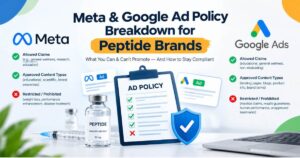
Peptides are restricted on the majority of the advertising platforms because they are connected to health, performance, and research chemicals.
Platform Policy Overview
| Platform | Classification | Result |
| Google Ads | Healthcare and pharmaceutical-related content | Restricted or limited approval |
| Meta Ads | Unverified health products or supplements | Frequent rejection |
| TikTok Ads | Medical or performance enhancement claims | Limited approval |
The rejection is typically not manual. It is triggered by automated systems that scan:
- Ad copy language
- Landing page content
- Product descriptions
- Website structure
2. The Main Reasons Ads Get Flagged
Peptide ads are most often rejected due to specific language patterns and content signals.
High-Risk Trigger Categories
| Category | Examples |
| Health claims | cure, treat, heal, reduce pain |
| Body transformation | muscle growth, fat loss, anti-aging |
| Medical terminology | injection, dosage, subcutaneous |
| Disease references | inflammation, injury recovery |
Even indirect claims such as “supports recovery” or “enhances performance” can trigger moderation systems.
3. Safe vs Unsafe Advertising Language
Successful peptide advertisers shift from outcome-based messaging to product-focused communication.
Unsafe Language for Peptide Ads
- This product improves muscle growth
- Reduces inflammation
- Helps recovery from injury
- Anti-aging effects
Safe Language for Peptide Ads
- Third-party tested peptides
- Research-use only compounds
- High purity manufacturing standards
- Certificate of analysis available
- Fast and discreet shipping
The key principle is to describe attributes, not outcomes.
4. Why Your Paid Advertising Strategy Is Failing
Most peptide brands fail not because of poor products, but because of incorrect ad structure.
Common Mistakes
- Running direct conversion campaigns too early
- High ad spend without testing compliance
- No funnel structure
- Using supplement-style marketing language
- No separation between awareness and conversion campaigns
These issues lead to repeated rejection cycles and wasted budgets.
5. A Proven Compliance-Based Advertising Framework
Instead of direct selling, peptide brands must use a structured funnel system.
Funnel Structure
| Stage | Objective | Ad Type |
| Awareness | Educate audience | Blog and informational ads |
| Consideration | Build trust | Guides and research content |
| Conversion | Drive sales | Retargeting campaigns |
High-Converting Compliance Funnel for Peptide Ads
Awareness Stage
- Educational content about peptide research
- Safety and compliance explanations
Consideration Stage
- Comparison guides
- Product quality breakdowns
Conversion Stage
- Brand trust messaging
- Testimonials and proof of quality
This structure significantly reduces ad rejection rates.
6. Google Ads vs Meta Ads Strategy
Google Ads Service Strategy
Google requires stricter compliance but offers more stability.
Requirements:
- LegitScript certification
- Compliant landing pages
- No medical claims
Best strategy:
- Target informational and research-based keywords
- Focus on product quality and compliance
- Avoid outcome-based messaging
Meta Ads Strategy
Meta is more restrictive and less predictable.
Best approach:
- Educational blog traffic campaigns
- Retargeting warm audiences only
- Avoid direct product promotion
Worst approach:
- Direct peptide sales ads
- Before and after visuals
- Health-related claims
7. How Ad Spend Gets Wasted
Many peptide brands lose budget due to poor campaign structure.
Inefficient Spending Patterns
- Scaling too early
- No testing phase
- Ignoring rejection feedback
- No audience segmentation
Optimized Spending Model
| Stage | Budget Range | Focus |
| Testing | Low budget | Creative validation |
| Optimization | Medium budget | Funnel refinement |
| Scaling | High budget | Retargeting and expansion |
8. Compliance Checklist Before Running Ads
Before launching any campaign, ensure the following:
- No medical or disease-related claims
- No injection or dosage language
- Landing page is compliant
- Product descriptions focus on attributes
- Clear disclaimers included
- Verified business account setup completed
9. Alternative Advertising Channels
When Google and Meta are restrictive, consider additional channels.
Effective Alternatives
| Channel | Benefit |
| Native ads | Editorial-style flexibility |
| Podcasts | High-trust audiences |
| Reddit ads | Niche community targeting |
| Email marketing | No platform restrictions |
| Affiliate marketing | Scalable distribution |
10. Long-Term Strategy for Scaling Ads
Successful peptide brands build systems, not isolated campaigns.
A scalable system includes:
- Compliance-first creative process
- Structured funnel strategy
- Multi-channel distribution
- Continuous tracking and optimization
- Rejection analysis and feedback loops
This is the cornerstone of paid advertising in regulated industries.
The Reality
This differs from business to business or supplement marketing as much as the approach for peptide advertising is concerned. Success depends on:
- Compliance-first messaging
- Structured funnel design
- Hand-coded execution of controlled paid ads.
- Effective utilization of the Google Ads service and paid advertising service systems.
Brands that get compliance and positioning right can scale without recurring ad account problems. This is the point where the most trusted agency stands out! Peptide Marketing offers tailored solutions for peptide-focused digital marketing systems and compliant advertising strategies, specifically tailored to this sector.
Why do peptide ads get rejected so often?
Peptides are covered under the category of restricted healthcare or pharmaceutical products and automatically filtered out by ad platforms.
Can I run Google Ads for peptides safely?
Yes, but you need a compliance setup such as LegitScript certification and strictly controlled ad copy.
What is the safest way to scale paid advertising?
Adopt an educational funnel strategy, targeting warm audiences and providing information along the way.
Why does Meta reject peptide ads more than Google?
Meta's automated detection systems are the backbone of its work and identify health-related terms in that automation, but not necessarily in context.
Do I need a Google Ads service for peptides?
Yes, because compliance setup, keyword targeting, and funnel strategy require specialized expertise to avoid account bans and wasted ad spend.