
The problem for most peptide brands isn’t that people don’t want them or that they are not of good quality, but rather that the marketing system is constructed by agencies that don’t fully know how buyer choices in this segment are influenced by trust, science, and compliance.
Many brands enter with the mindset of having a strong scaling effect, but that leaves them with mixed performances, poor conversion rates, and messaging that doesn’t resonate with informed buyers. Simply put, the more you scale on the wrong platform, the sooner you lose your budget, trust, and positioning in the market.
In this blog, we will discuss why those systems break, where they fail in the buyer journey, and what structure actually works for sustainable peptide brand growth.
Why Generalist Agencies Fail in Peptide Marketing
Generalist agencies apply standard supplement marketing frameworks that are not designed for high-scrutiny peptide brands or research-driven health categories.
- Peptide ads get rejected or underperform
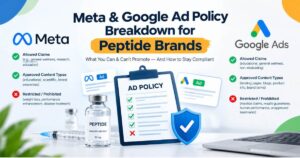
Generalist agencies tend to have language and direct claims that are inconsistent with platform policies and buyer expectations. This results in ad restrictions, low delivery, or engagement.
The goal of communication in peptide brands is to convey information, not to persuade. This alignment has to be there; campaigns will not work, no matter how much money is spent.
For Detailed Information, read Why Your Peptide Ads Are Getting Rejected
- Peptide funnels fail to convert traffic
Most of the funnels are built for impulse-type products rather than ones that involve a lot of research and decision-making. Before converting, peptide buyers expect to understand how the peptides work and get signals of credibility. In the absence of this information, consumers are lost at the very beginning of the decision. So, you end up with traffic that is not converting.
- Fail to build long-term authority
Whereas generalist agencies are about short-term performance and not topical authority in search and content. This means there is a dependency on paid traffic, and organic growth is not possible. The more time that passes, the higher the acquisition cost, and the lower the scalability. Authority is not usually considered a growth asset.
- Inconsistent Messaging across peptide campaigns
Generalist agencies tend to use templates from unrelated fields, resulting in inconsistent messaging in ads, landing pages, and content. This can decrease trust as peptide purchasers are greatly influenced by consistency and scientific framing. If the message changes too frequently, then perceived credibility is lower.
Peptide-Specific Marketing System Requirements
Successful scaling of peptide brands demands communication systems that are structured and surround education, trust-building, and multiple conversion logic paths, and not just direct response advertising.
- Agency work structure
Regulated or high-scrutiny health communication settings are understood by effective agencies in this space. They prefer content that is compliance-safe, education content systems, and buyer journeys that are structured. They are not in charge of campaign execution, but rather system design.
- High-performing peptide marketing system
A functional system usually has a learning element to promote awareness, authority pages for validation, and organized conversion layers for decision support. Each layer responds to a different part of the purchaser’s purchase evaluation. This helps to minimize friction and boost trust before buying.
- Authority-driven brands outperform ad-driven brands
Authority brands build trust through their content, their SEO, and their positioning of the brand in a consistent way, which helps to decrease the reliance on paid acquisition. Brands that rely on ads end up not generating demand when the advertising campaign is finished. Over time, authority systems maintain traffic and conversions.
What to Look for When Hiring a Peptide Marketing Agency
When you are hiring a peptide marketing agency, you should keep in mind several key points. There are several aspects to consider when hiring a peptide marketing agency. The right agency will showcase its experience in high-trust health categories and systems of structured content, as well as long-term authority-building capabilities, in addition to managing paid campaigns.
Conclusion
Brands that move to a more structured authority-based marketing system generally grow more predictably. In contrast, those that have been using generalist marketing systems have had more volatile performance and growth. If you want to explore how a structured peptide marketing system is created, then you can contact Peptide Marketing for the best possible outcome.
Why do most marketing agencies struggle with peptide brands?
Peptides are semi-health-regulated niche products, and that is why marketing groups have a hard time with them. Most agencies use generic supplements or e-commerce approaches that are far from research-based, as peptide buyers are. This results in low trust signals and lower conversion rates. For regulated or semi-regulated health categories, a special approach is sometimes necessary. The real problem is seldom the budget; it's the strategy.
What makes peptide marketing different from supplement marketing?
In order to get converted, peptide marketing needs more explanation, credibility building, as well as informativeness. In the supplement category, marketing is often driven by impulse, and this isn't necessarily conveyed to the reader. Buyers assess mechanisms and trust before buying. This alters the ways in which funnels and messaging should be designed.
Why do peptide ads get restricted on platforms?
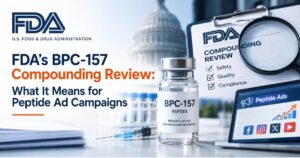
Ad platforms have a strict policy on health-related claims, particularly where the message may imply achieving medical benefits or health claims that are not clinically supported. Generalist agencies may accidentally break these rules when they write. This means that ads might be restricted or rejected. When communicating via messaging, it is important to craft it to comply with regulations carefully.
Do peptide brands need SEO or paid ads more?
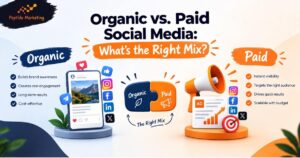
They both can be used, but SEO and authority building are often more conducive to steady long-term growth. In this area, paid ads can deliver traffic to your website very fast, but they aren't always reliable. The more you repeat the process of SEO, the more trust you will develop. Strategically, both are used in the most stable systems.
What should a peptide marketing agency focus on first?
The first thing is to grasp the buyer journey and how trust can be developed in research-intensive markets. If not, campaigns do not work, no matter how well they are executed. The agency should then develop a system of structured messaging and educational content. The foundation is what makes it long-term and scalable.