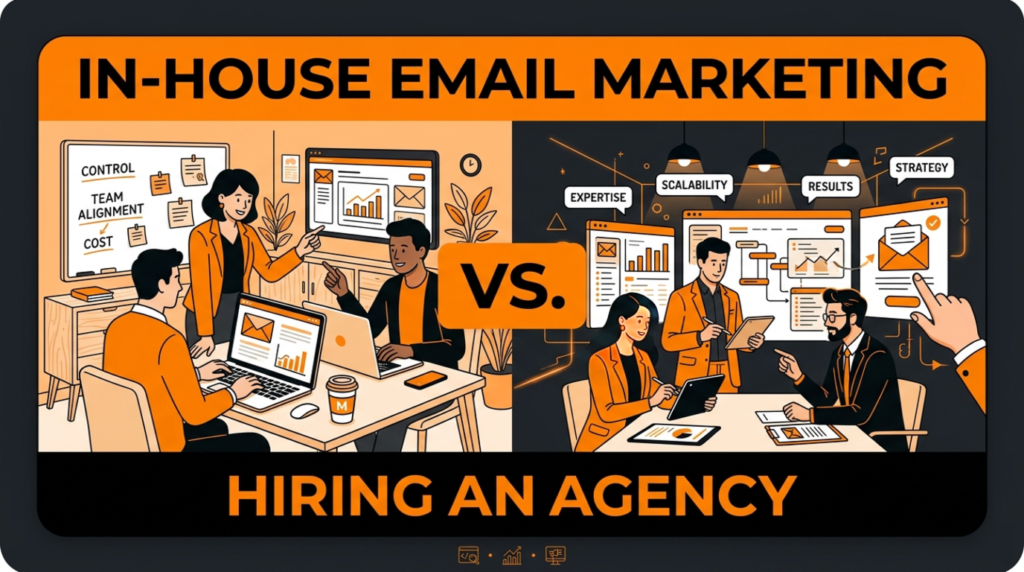
At some point in time, every growing brand will ask this question: Do I need to hire an in-house team to handle my email marketing, or should I hire an agency? There is no “right or wrong” answer. This will rely upon the amount of money you have, the timeframe, and the significance of central email to your earnings at this moment. Here are the steps to follow.
What “In-House” Actually Means
In-house means that you have your own staffing team, whether one person or a team, who owns your strategy, copy, design, and send. They are part of your team, know your product inside and out, and collaborate with your other teams daily.
That closeness is valuable. But it comes with real costs beyond salary: recruiting time, onboarding, benefits, tools, and the stretch it takes someone to actually get good at the job.
What “Agency” Actually Means
An agency is a team you rent, not hire. You get a strategist, copywriter, designer, and often a technical specialist, without adding anyone to your payroll. You’re paying for expertise that’s already been built from working across dozens of other brands.
The tradeoff is that they’re not fully embedded in your business, and you’re one of several clients they’re managing at once.
Cost Comparison: In-House vs. Agency
| In-House Team | Agency | |
| Upfront cost | High includes salary, benefits, and tools before any work starts | Low to moderate, no hiring or training cost |
| Ongoing monthly cost | Fixed, regardless of output or season | Flexible, can scale up or down with your needs |
| Time to full productivity | Slow, months of hiring plus a ramp-up period | Fast, usually a matter of weeks |
| Hidden costs | Turnover, retraining, tool subscriptions | Minimal, mostly bundled into the retainer |
Agencies tend to look more expensive month to month at first glance. In-house tends to look cheaper on paper until you factor in benefits, tools, and the slow ramp-up before that hire is producing real results.
Pros and Cons of an Email Marketing Agency
| Pros | Cons |
| Immediate access to a full team, not just one person | Less day-to-day, real-time collaboration |
| Exposure to what’s working across many other brands | A learning curve while they get to know your brand |
| No hiring, training, or turnover risk on your end | You’re one of several accounts they manage |
| Easy to scale the relationship up or down | Less built-in familiarity with your internal processes |
As the Forbes Agency Council notes, agencies bring a broader, cross-industry perspective that a single in-house hire, focused only on your brand, usually can’t match.
Pros and Cons of an In-House Team
| Pros | Cons |
| Full-time focus on just your brand | Higher fixed cost, regardless of performance |
| Faster internal communication and alignment | Slower to launch, since hiring and onboarding take time |
| Deep, compounding product knowledge over time | Losing one key person can set your program back significantly |
| Easier day-to-day collaboration with other teams | Harder to scale quickly if needs change |
When Should You Hire an Agency vs. Build In-House?
A simple way to decide:
- Choose an agency: Opt for an agency when you want results fast, you haven’t got the budget for a full in-house team, or you want results without the management hassle.
- Choose in-house: If email is already an important source of your revenue, you have the budget and workforce to maintain a team, and can give that team time to get up and running, try in-house.
- Consider a hybrid approach: Typically, it is one person internally who has brand awareness, brand knowledge, and the day-to-day coordination responsibilities, and an agency that turns to strategy, copy, design, and technical execution. A middle ground that is common once the brand has outgrown the limits of a single freelancer and isn’t quite ready to hire a full internal team.
You’re getting someone who’s really into the brand and a team that’s already familiar with what works. When opting for the agency option, our agency selection guide tells you what you should expect, watch out for, and ask questions before you sign.
If you’re choosing the agency route, our guide on how to choose an email marketing agency breaks down exactly what to look for, the red flags to avoid, and the questions worth asking before you sign.
Measuring ROI: Agency vs. Internal Team
Regardless, you should measure the same metrics: email ROI, list growth, deliverability, and customer value. The difference is predominantly time. Agencies are likely to see more tangible shifts earlier on because they have the frameworks in place that have already proven to work elsewhere.
In-house teams have a longer timeframe to become stable, as some time is required to hire and train the personnel before any production. After a reasonable distance on any of the paths, if you don’t get movement, STOP and don’t push through!
Conclusion
The placement of a brand on this continuum may depend on how niche the audience is. It’s an area of specialization that goes to the heart of the business for peptide and research-chemical brands: compliance limits, scientific education, and messaging that can’t be overstated. That’s a lot to hand off to a generalist hire or a brand-new agency relationship.
It’s also exactly why Peptide Marketing exists, working only with peptide brands, so there’s no learning curve on the audience or the compliance line. Whether you land at an agency, in-house, or somewhere in between, we’re glad to be a sounding board while you figure out what fits.
Is it better to hire an email marketing agency or build an in-house team?
It will depend on budget and time frame considerations. For brands that are looking to get things done fast and want to get the job done right, agencies are the ideal choice. In-house is great for brands that have the budget for an in-house team and the time to wait for it to get going.
When should I hire an email marketing agency vs. building in-house?
Use an agency if you require results quickly, or you don't have the budget to hire a team of people. There's a time when email is a significant revenue stream, and you can invest in building in-house teams.
How does agency ROI compare to an internal team's ROI?
Agencies are likely to deliver results sooner, as they come with systems already in place. In-house teams can generate more in-depth brand knowledge in the long run, but require more time to get up and running.
Is an in-house or an agency better for a small business?
At the beginning, most small businesses begin with an agency or freelancer because it is difficult to justify having a full team in-house during the initial stages. Some move to a hybrid or fully in-house arrangement as their revenue increases.