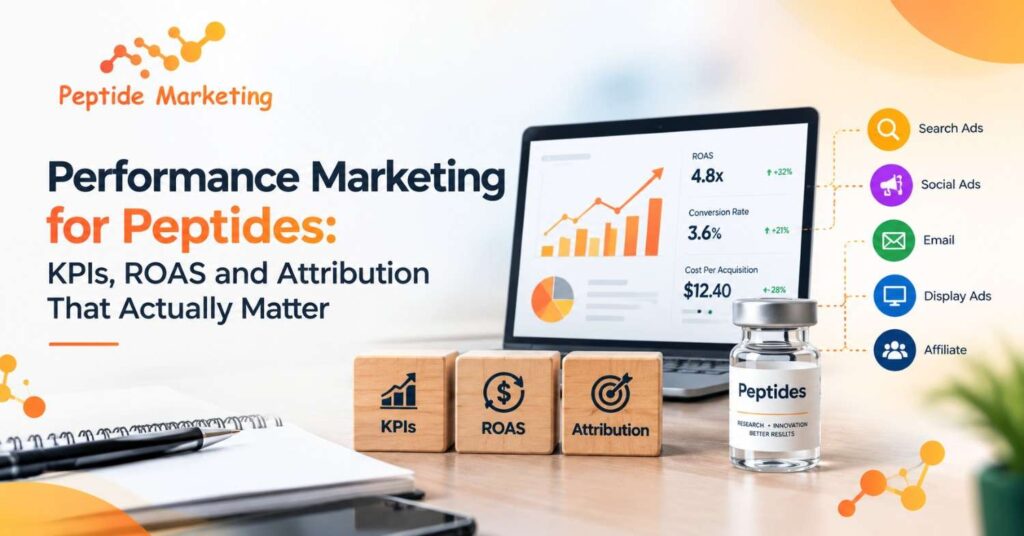
Your ad dashboard says you’re winning. Your bank account says otherwise. Sound familiar? Many peptide brands face this. Ad accounts get flagged. Tracking loses data. Buyers take weeks to decide. So the numbers never match.
This guide fixes that. You’ll learn which numbers matter, how to set a ROAS target, and how to track your sales.
What Is Performance Marketing for Peptides?
Performance marketing for peptides is about what really matters. That can be in many forms, like orders, sign-ups, or repeat purchases. You evaluate your growth in real terms.
Peptides make this harder. Ad platforms limit what you can say. Buyers research for weeks. Many first hear about you on a forum or a podcast. So your tracking is not like any generalised online store.
Key Business KPIs, Formulas by Category
| Category | KPI | Formula |
| Customer Acquisition | Customer Acquisition Cost (CAC) | Total Ad Spend ÷ Number of New Customers |
| Customer Value | Customer Lifetime Value (LTV) | Average Order Value × Purchase Frequency × Customer Lifespan |
| Marketing Efficiency | LTV-to-CAC Ratio | Customer Lifetime Value (LTV) ÷ Customer Acquisition Cost (CAC) |
| Customer Retention | Repeat Purchase Rate | (Customers Who Purchased More Than Once ÷ Total Customers) × 100 |
| Sales Performance | Average Order Value (AOV) | Total Revenue ÷ Number of Orders |
| Profitability | Contribution Margin (Amount) | Revenue − Product Cost − Shipping − Fees − Ad Spend |
| Profitability | Contribution Margin (%) | (Contribution Margin ÷ Revenue) × 100 |
ROAS: Find Your Break-Even First
ROAS means return on ad spend. You get it by dividing revenue by ad spend. Make $3,000 from $1,000 in ads, and your ROAS is 3.0.
But what’s a good ROAS? It depends on your margin. Use this formula:
Break-even ROAS = 1 ÷ gross margin
- 50% margin: break-even is 2.0
- 60% margin: break-even is 1.67
- 70% margin: break-even is 1.43
Say your first-order ROAS is below break-even. That’s not always bad. If customers reorder, you can earn the profit later. But you need proof. Check your repeat rate before you trust it.
Track two types of ROAS. Front-end ROAS covers the first purchase. Blended ROAS is total revenue divided by total ad spend. Blended is harder to fake. It shows what your business really earns.
Ready to grow your budget? Read our guide on how to scale peptide ads.
Attribution: Make Google Analytics 4 Tell the Truth
Google Analytics 4 (GA4) is your main reporting tool. But it misses sales unless you set it up well. Start here:
- Mark purchases as key events. Pass the order value too. Then GA4 revenue matches your store.
- Add UTM tags to every link. Ads, emails, influencer posts. Untagged clicks show up as “Direct” and hide what works.
- Use server-side tracking. Tools like the Meta Conversions API catch sales that ad blockers block.
- Compare attribution models. Look at data-driven and last-click side by side. A big gap means your early channels are working harder than they look.
- Ask buyers directly. Add a thank-you page question: “How did you first hear about us?” If someone says “Reddit” and GA4 says “Direct,” trust the buyer.
No single tool tells the whole story. Platform data, GA4, and survey answers each show a piece. Read them together. Then check the result against your blended ROAS.
Which Channels Work Best?
Paid ads can work. But ad platforms push back on peptide brands. Ads get rejected. Accounts get flagged. So don’t rely on ads alone. Build channels you own.
- Email and SMS: These drive repeat orders. That lifts your LTV.
- SEO and content: Organic traffic keeps coming even if an ad account shuts down—our guide on SEO vs PPC shows which to fund first. Our peptide digital marketing services cover the organic side.
- Social and creator content: Helpful posts build trust before the click. See how we run performance marketing for peptides on social media.
- Lab results and reviews: Show third-party test results and real reviews on your pages. They boost sales from every channel.
Keep every ad and landing page compliant. A high ROAS means nothing if the account gets banned.
How Long Until You See Results?
You’ll see early signs in 2 to 4 weeks. You’ll learn which ads get clicks and which pages convert.
Solid CAC and repeat data take longer. Plan on 60 to 90 days. You need enough orders, and enough time for buyers to come back. Don’t judge a campaign after one week. That’s how good campaigns die.
Measure What Pays You Back
The brands that grow aren’t chasing the biggest ROAS screenshot. They know their break-even. They track repeat buyers. They trust their own data over any one platform.
Want help building that system? Talk to a Peptide Marketing Agency USA that works only with peptide brands.
FAQs
What is performance marketing for peptides?
It’s marketing you pay for and judge by results, like orders and repeat buys. It’s built around the ad rules peptide brands face.
Which KPIs matter most for peptide brands (ROAS, CAC, LTV)?
All three. CAC shows what a customer costs. LTV shows what they’re worth. ROAS shows how well your ad spend turns into sales. Add repeat purchase rate and contribution margin too.
How do I track conversions on a peptide store with limited ad platforms?
Set up purchase events in GA4. Tag every link with UTMs. Add server-side tracking. Then add a post-purchase survey to catch sources that analytics can’t see.
What is a good ROAS for a peptide ecommerce brand?
One that beats your break-even ROAS (1 ÷ gross margin). With a 60% margin, you need above 1.67 to profit on the first order. With strong repeat sales, you can accept less.
Which channels work best for peptide performance marketing?
Use a mix. Email and SMS for repeat sales. SEO for steady traffic. Paid social or search where rules allow. Add creator content and lab results.
How long before performance marketing shows results?
Early signs show in 2 to 4 weeks. Reliable CAC and LTV numbers take 60 to 90 days.