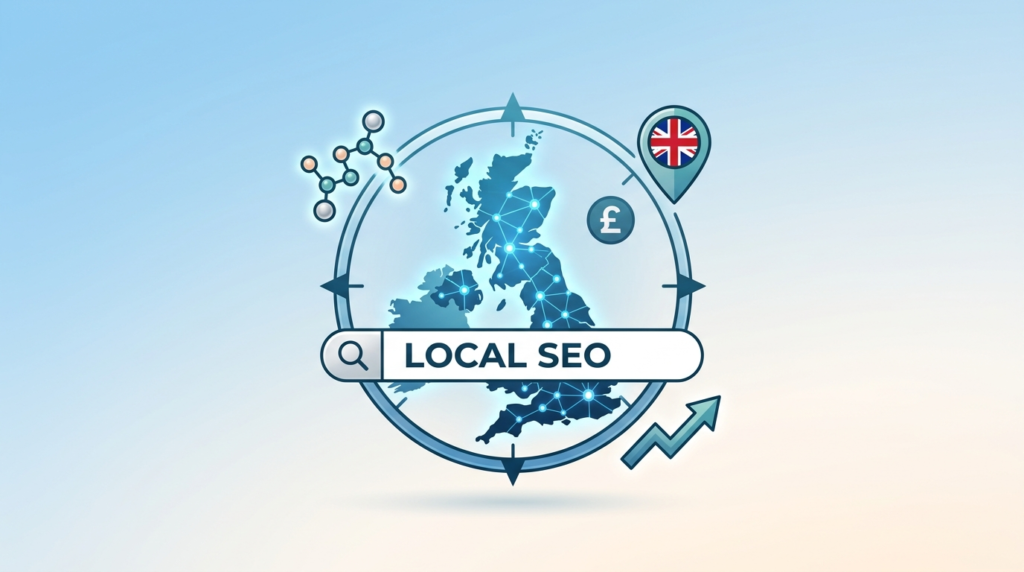
Quick Answer: The elements of local SEO for UK peptide businesses involve having a tightly optimised Google Business Profile, consistent citations and location pages that communicate something. It’s not the same playbook as a plumber or a dentist uses. Here, where YMYL content is being eyed, trust signals and NAP consistency are a lot more important than anywhere else.
There is a problem people don’t tell you about when they begin a peptide company: You can’t buy visibility. Meta restricts you. Google Ads banners you. You might have to move your TikTok account before the first campaign ends.TikTok may take your account away before the first campaign has fully been spent. So what’s left? Local SEO. That’s really it.
Trouble is, most local SEO strategy UK content is written for a completely different business, e.g., plumbers, coffee shops, a dental clinic down the road. None of it touches research chemical compliance, YMYL scrutiny, or the fact that your buyer has probably read the study before they’ve even opened your homepage. This guide fills that gap.
Why Doesn’t Standard Local SEO Advice Work for Peptide Brands?
Ask a generic local SEO agency in the UK what to do, and you’ll get the same answer every time: collect five-star reviews, fill out your profile, wait! Not wrong, exactly. Just incomplete.
Google puts peptides and research chemical content in the same bucket as medical and financial advice: YMYL, Your Money or Your Life. That single classification changes everything downstream. Your Google Maps SEO and citation strategy needs to sit atop real expertise, not just a nicely filled-out listing.
Two things make this harder than most industries:
- The regulatory line keeps moving. Peptides sit between research chemicals and supplements, and that grey area means a vague listing can invite a platform review you didn’t want.
- Your buyer already knows more than most. Researchers, biohackers, clinicians- your actual customers think content doesn’t fool them. They’ll notice, and leave for whoever actually knows the subject.
What Should You Actually Do With Your Google Business Profile?
Your Google Business Profile is probably still your single best local SEO asset, full stop. For peptide brands, three things carry more weight than usual.
- Get the category right: Vague or misleading categories are one of the fastest routes to a suspension.
- Watch your language: Keep claims factual and research-oriented, nothing implying human consumption or medical use.
- Seed your Q&A section: Real, specific questions, dosing formats, COAs, shipping regions, beat generic praise every time.
| Local Ranking Factor | Generic UK Business | Peptide Brand |
| Reviews | Star rating matters most | Rating plus specificity (COAs, purity, service) matters more |
| Categories | Broad match is fine | Precise, compliant categories are essential |
| NAP consistency | Helps rankings | Helps rankings and lowers platform risk |
| Content depth | Short local pages work | Needs YMYL-level depth and citations |
Why Does NAP Consistency Matter More for Peptide Companies?
NAP consistency Name, Address, Phone number) shows up in every local SEO tips UK article ever written. For a peptide business, though, getting this wrong isn’t just an SEO problem. Building accurate local citations across trusted UK directories helps search engines verify your business information and strengthens your overall local SEO presence. Inconsistent listings leave a messy paper trail, and that looks unprofessional to both Google and the payment processors watching your footprint.
So where should you list your business? Prioritise local citations and directories that:
- Serve the biotech, supplement, or research chemical space specifically, not general local listings
- Let you write a detailed, compliant business description
- Are indexed and trusted by Google
Keep one source-of-truth document with your name, address, and phone number, and check it every quarter. Nobody enjoys this step. It’s still one of the cheapest wins you’ll find in local SEO.
What Does a Real Local SEO Strategy Look Like for Peptide Brands?
Strip it down and a local SEO strategy UK for this industry rests on three things.
Location and service pages, done properly: If you serve several UK regions, build a dedicated page for each, not thin duplicates with the city name swapped out, but pages with real local context and framing that fits that market.
Content that actually builds E-E-A-T: Google wants Experience, Expertise, Authoritativeness, and Trust. That means author bios with real credentials, cited research, and sourcing you’re not hiding. Keyword-stuffed posts won’t cut it.
Structured data, quietly working in the background: FAQ schema and local business schema help your pages show up in featured snippets and AI-generated answers, and that matters more every quarter as search drifts toward AI overviews.
How Do You Know Your Local SEO Is Actually Working?
The bottom line is that the rankings don’t mean much by themselves. Track these instead:
- Local pack visibility: The service terms for your core services must be for each region separately.
- Google Business Profile actions: Not just views, but also calls and direction requests, are available as Google Business Profile actions.
- Local Citation accuracy: Every quarter in your top directories.
- Organic conversion rate: A good ranking page that does not convert is not a good ranking page.
Check these monthly. Local SEO in a regulated niche moves slower than most industries; patience and consistent tracking beat chasing quick wins.
How Do You Choose a Local SEO Agency That Actually Understands This Niche?
Plenty of agencies claim local SEO services UK expertise. Far fewer understand yours. Before hiring anyone, ask:
- Have they worked in a regulated or YMYL industry before, or is this new territory for them?
- Can they show a compliant content sample, not just a folder of generic local pages?
- Do they understand advertising restrictions well enough to line up SEO with the rest of your marketing?
A generalised agency can technically run local SEO. A specialist SEO service agency is the one that protects your visibility while doing it, and that difference shows up fast.
What Mistakes Do Peptide Brands Keep Making With Local SEO?
- Treating the Google Business Profile like something you set up once and forget about
- Letting NAP details drift out of sync across supplier directories
- Publishing thin location pages that don’t say anything region-specific
- Skipping schema markup entirely
- Creating content that comes across as an advertisement rather than useful, a main factor for bad ranking and bad customer trust.
Conclusion
Don’t think local peptide brand marketing is less important than everyone else; think it is more research-based. Compliance, citation, and content layers are a bit of a niche experience that most generalist agencies fail to understand. That’s where Peptide Marketing comes in, and tailors its efforts to help peptide and biotech brands in the UK get genuine organic visibility without the platform risk that comes with generic strategies.
What is local SEO for peptide businesses?
Optimising your online presence, Google Business Profile, citations, and location-based content so that peptide buyers in specific UK locations can find you without paid ads.
Is Google Maps SEO different for regulated products?
Yes. The risk factors increase when you're in the YMYL category, in terms of category selection, description wording, and handling of reviews.
How long does local SEO take to show results?
Most of the peptide brands are seeing actual change in the 3- to 6-month time frame, but the citation and authority are growing beyond that.
Do I need a UK-specific local SEO strategy if I sell nationally?
Yes. Even though you're selling online, local information such as postcodes, regional searches and “near me” queries still have an impact on your national rankings.
What's the biggest local SEO risk for peptide companies?
Inconsistency in NAP data and lack of consistency in categorisation. Both can cause a platform review, not just hurt rankings.