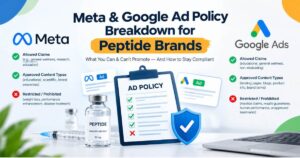
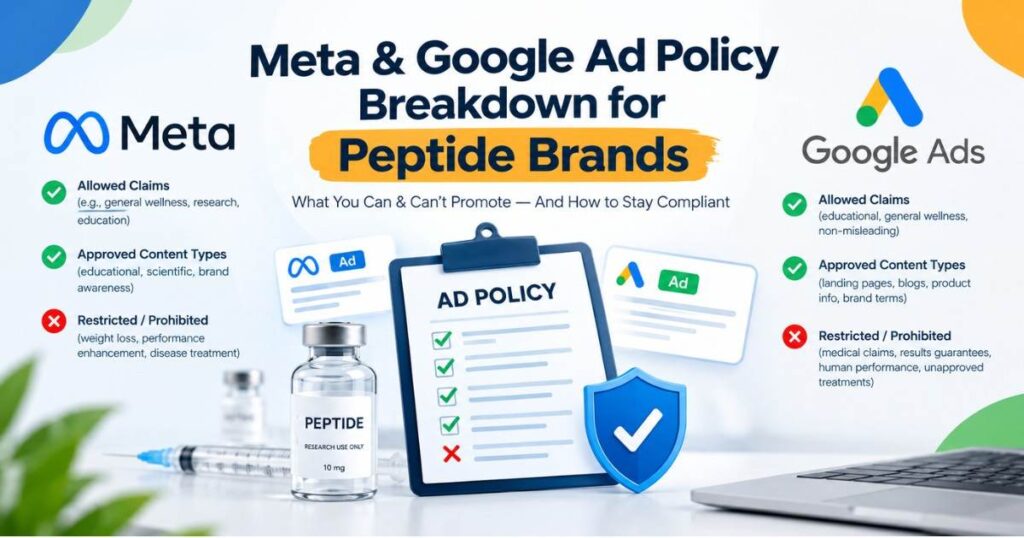
Peptide brands don’t get one rulebook. They get two, and neither one explains itself well. This breaks down how Meta and Google actually handle peptide ads, where they differ, and what to check before you spend another dollar.
Why Peptide Ads Get Flagged More Than Other Categories
Meta Advertising Standards and Health Claims
Meta’s Advertising Standards restrict unapproved pharmaceutical claims. Peptides sit close to that line by default. The compound doesn’t need to be illegal. It just needs to sound like a drug. Meta’s systems scan the ad text, the image, and the landing page. A human usually isn’t involved until after the rejection.
If your campaigns are already facing disapprovals, understanding the common reasons behind them can help you avoid repeated mistakes. Learn more about why your peptide ads are getting rejected and the steps brands can take to improve approval chances.
Google Ads Healthcare & Medicines Policy, Explained
Google splits approved drugs from everything else. Unapproved peptides land in the restricted group. Google reviews healthcare-adjacent ads more by hand than Meta does. That means slower approval. It also means fewer random surprises once you’re approved.
Meta Ads Peptide Restrictions: What Actually Triggers Rejection
Peptide Facebook Ad Rejection: The Common Triggers
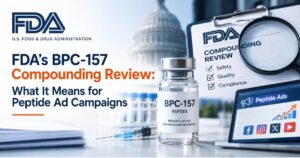
Most rejections come from the same handful of things. Outcome words like “heals” or “cures”. Before-and-after photos. Dosage instructions in the ad copy. Any hint of FDA approval. None of this is new. It just gets enforced more strictly while a compound is under regulatory review, which several peptides are right now.
Ad copy that gets rejected vs. copy that clears review
| Ad Element | Rejection Risk | Compliant Version |
| “Clinically proven to heal tendons” | High | “Studied for tissue-related applications in research settings” |
| Before/after body photos | High | Product shot or lifestyle image only |
| “FDA-approved peptide therapy” | High | “Currently unapproved by the FDA” |
| Specific dosage in ad text | Medium | “Consult a licensed provider for guidance.” |
| “Popular in longevity research” | Low | Keep as is |
Google Ads Peptide Brand Approval: How It’s Different From Meta
Google Ads approval moves slower than Meta’s. Where Meta often auto-rejects on a keyword match, Google is more likely to ask for landing page changes or business verification first. Google also escalates faster. A few repeat violations, and the whole account can get restricted, not just the ad.
Meta vs. Google, side by side
| Factor | Meta | |
| Review Method | Mostly automated | Mixed, more manual for healthcare |
| Speed | Fast, often minutes | Slower, can take days |
| Appeal Process | In-platform, limited detail | More documentation-based |
| Typical Penalty | Ad disapproval first | Account restriction more common |
| Best Fit For | Broad reach, top of funnel | Search intent, informed buyers |
Peptide Ad Policy 2026: What’s Changed This Year
Both platforms tightened up in 2026. More peptides moved through regulatory review, and enforcement followed. Expect more manual escalation on flagged keywords. Expect closer scrutiny of the landing page behind an ad, not just the ad itself. Compliance now has to cover the whole path, not just the headline.
Policy Violation vs. Account Restriction: What’s the Difference
A violation is tied to one ad. It gets disapproved; you fix it, and you resubmit. That’s usually the end of it. The restriction is bigger. It limits or shuts down the whole account, usually after repeat violations or one serious one. One bad ad rarely kills a business. A pattern of them can.
Can You Appeal a Rejected Peptide Ad?
Yes. And appeals do work, but only when something actually changes. Resubmitting the same ad with different wording rarely passes. Build the appeal around what likely got flagged, not around proving the platform wrong.
How to Write Compliant Peptide Ad Copy From the Start
The easiest way to avoid rejection is to write copy that never needs fixing. Lead with what the product is, not what it promises. Use research language instead of outcome language. If a claim can’t be backed up, leave it out.
Once your campaigns follow compliance guidelines, the next challenge is increasing spend without creating new risks. Brands looking to grow can explore strategies on how to scale peptide ads from $5k to $50k/month while maintaining campaign stability.
This is the gap that shows up when ads and landing pages get built separately instead of together. As a compliance-first peptide marketing agency, we build both at the same time.
Conclusion
Getting flagged once isn’t the end of a campaign. Getting flagged repeatedly without knowing why usually is.
If you want a full audit of where your current ads and landing pages stand against both platforms’ policies, that’s exactly what our Compliance & Risk Audit service is built for.
FAQs
Why do Meta and Google flag peptide ads more than other product categories?
Peptides sit close to pharmaceutical claims. Both platforms watch that space more closely, especially during active regulatory review.
What specific words or claims trigger peptide ad rejections on Meta?
Words like “cures” or “heals.” Before-and-after photos. Dosage instructions. Any suggestion of FDA approval.
Does Google Ads treat research peptides differently from Meta?
Yes. Google reviews more by hand and asks for more documentation. Meta leans on automated scans and fast rejections.
- Can a peptide brand appeal a rejected ad, and does it usually work?
Sometimes. It works when the actual claim or image changes. Small wording tweaks on the same ad rarely get approved.
What’s the difference between a policy violation and an account restriction?
A violation hits one ad and is usually fixable. A restriction hits the whole account and usually follows repeat or serious violations.
How often do Meta/Google update their health-and-wellness ad policies?
On a rolling basis. Updates often follow regulatory news more than a fixed calendar, which is part of why enforcement can shift fast.