Here’s the important thing about FDA news and ad compliance: they move on different clocks. FDA takes months, sometimes years, to finalize a rule. Platforms can mark a keyword that is in a headline as a red flag within a week. It’s not a legal change, at this point, but your risk is changed nonetheless with this review.
In this blog, let’s look at what this means, why it shouldn’t matter to your ad account, and what you need to change this week.
What FDA Actually Decided
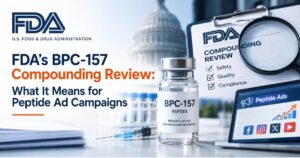
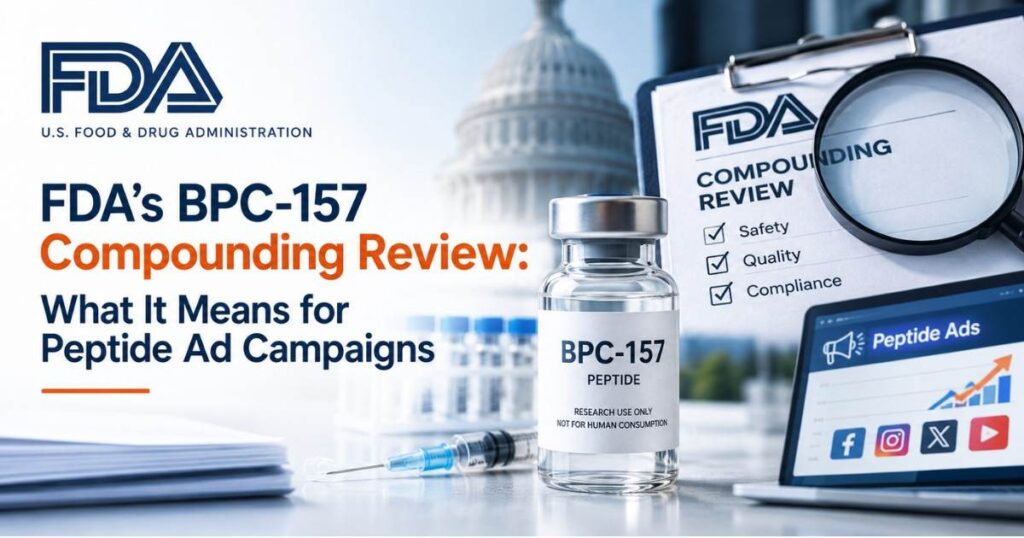
Seven peptides, such as BPC-157, TB-500, and KPV, were reviewed by the FDA’s Pharmacy Compounding Advisory Committee in two days. The committee came back 8-6 on a vote to place BPC-157 on the 503A Bulks List, which would allow licensed compounding pharmacies to prepare it for patients who have a prescription.
Why the Vote Isn’t FDA Approval
An advisory vote is only advice. BPC-157 won’t make it into the list until FDA conducts its own rulemaking. It’s not set in stone!
What is FDA 503A Compounding?
BPC-157 came off FDA’s restricted Category 2 list back in April 2026. That is good news, it is, but not the same as 503A approval. Removing a restricted list allows for more opportunities in terms of nomination. Do not infer that the compound is approved, tested, or cleared for OTC sale. It’s still an unapproved drug.
Does This Ban BPC-157 Ads?
No. FDA is not involved in ad policy. Meta and Google do, and their policies already limit unproven drug claims, so no new laws were unleashed on advertisers. The one thing that’s different is the scrutiny. The more something is in the news, the more it will be flagged, reviewed manually, and rejected during a period of active regulatory review. It’s not like your ad became worse. The surroundings surrounding it did.
Why This Raises Peptide Ad Account Risk
Ad platforms watch regulatory movement on injectables and weight-loss-adjacent products closely, and peptides sit right in that zone. When a compound’s status shifts, even in a non-binding vote, automated review systems start matching keywords harder and routing more accounts into manual review.
What’s getting flagged now
Brands running BPC-157 advertising restrictions are already reporting disapproval over before-and-after imagery, “cure” language, and healing claims with zero citation. None of that is a brand new policy. It’s just getting enforced with less patience than it was six months ago. We covered the mechanics of this in more depth in why peptide ads get rejected and how to fix them; worth a read if you’ve had a disapproval already.
Words to Cut From Your Ads
Pull anything that implies approval or proof: “FDA-cleared,” “clinically proven,” “cures,” “heals,” “repairs tendons,” “treats IBD.” Drop dosage instructions from ad copy too, since that reads as medical direction, not marketing. Before-and-after imagery tied to a medical outcome is a fast track to rejection right now.
Claims that get flagged vs. claims that pass review
| Ad Claim Type | Risk Level | Why | Compliant Alternative |
| “FDA-cleared BPC-157” | High | False regulatory claim | “Currently under FDA compounding review” |
| “Cures tendon injuries” | High | Unproven medical outcome | “Studied in preclinical models for tissue recovery” |
| Before/after healing photos | High | Implies guaranteed result | Product or process imagery only |
| Specific dosage in ad copy | Medium | Reads as medical direction | “Consult a licensed provider for dosing” |
| “Popular with athletes” | Low | Descriptive, not a health claim | Keep as is |
| “Ask your provider about BPC-157” | Low | Educational, no outcome promised | Keep as is |
Swap outcome promises for education. Say what BPC-157 is. Say what current research actually shows, which is early and mostly preclinical. Point people toward a licensed provider instead of promising a result. It’s a less flashy copy, but it’s a copy that stays alive.
Does This Apply Outside the US?
This review is a US process, tied to US compounding law, and it applies directly to US pharmacies. But ad enforcement doesn’t stop at a border. Meta and Google run global policy teams, so a claim flagged in your US campaigns can trigger review on the same ad account’s UK or Canadian campaigns too. If you’re advertising outside the US, keep half an eye on MHRA, Health Canada, and TGA as well. None of them have to wait for the FDA to act first.
Peptide Ad Compliance 2026: What To Do Now
Audit before you get flagged
Go through your live ads and landing pages against current platform policy, not what got approved eight months ago. Strip unproven claims. Check that any funnel touching a medical outcome routes through a prescription or screening step where one’s required.
Build a habit, not a one-time fix
If you’re running multiple ad accounts, set a recurring compliance check rather than waiting for a rejection email to tell you something’s wrong. For a fuller playbook on scaling RUO and peptide brands without tripping platform policy, our 2026 growth guide for peptide and RUO brands walks through the funnel and compliance side together.
Conclusion
As of now, BPC-157 remains unapproved by the FDA. Advertisers should weigh the account risk honestly and lean on evidence-based positioning while keeping an eye on the regulatory changes still working their way through. If you want someone else to check your current campaigns before an algorithm does, that’s exactly what our Compliance & Risk Audit is for, or take a look at how we approach things as a compliance-first peptide marketing agency.
FAQ
What is BPC-157, and why is it controversial?
It is a synthetic peptide that has been used primarily in animals to repair tissues and heal the gut. The controversy is the difference between the marketing and the meager amount of human clinical data.
Is BPC-157 legally available right now?
Yes, in some cases, through a licensed physician and compounding pharmacy. Not FDA-approved, not an over-the-counter supplement.
What do “Category 2” and “503A” mean, in plain terms?
Category 2 was the list of restricted compounds. Getting off of it doesn’t mean approving it. Once the medicine has been added to the Bulk List, 503A will allow a registered pharmacy to compound a substance for one particular patient’s prescription.
Can BPC-157 be trusted for healing claims in ads?
Not yet. This evidence is early and mostly preclinical. The claims do not meet the regulatory bar on user anecdotes for a health claim.
What should I check before running these campaigns?
Ensure that the landing page (if applicable) includes a prescription step and excludes outcome guarantees, and that the ad copy meets the current platform claim policy and is not from last year.