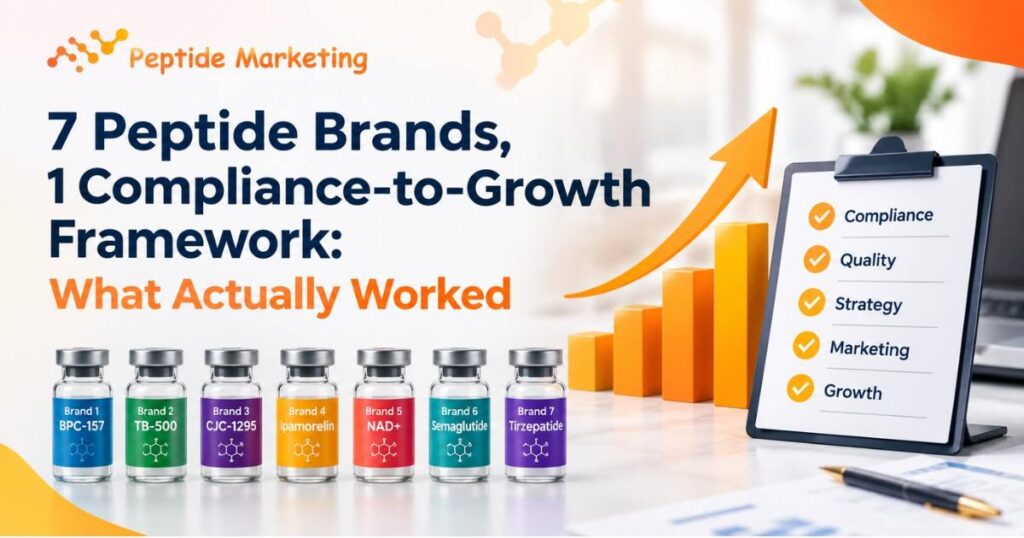
Seven brands. Seven different starting points. One framework that held up across all of them. Here’s what these peptide brand case studies actually show: the peptide brand marketing results behind them, and the one pattern that repeated across every single one.
What These 7 Brands Had in Common Before We Started
The Shared Problem: Compliance Came Last, Not First
Most of these brands didn’t fail because of bad products. They came to us with restricted ad accounts, non-compliant websites, or no marketing infrastructure at all, because compliance had been treated as a launch-day afterthought instead of the foundation. That’s the common thread across nearly every one of these peptide brand success stories. Every case here proves the same compliance-to-growth framework peptide brands actually need to operate in a regulated market.
The 7 brands, at a glance
| Brand | Market | Starting Challenge |
| Peptislim | Australia | TGA and Meta regional enforcement, high compliance bar |
| BodyLab | Not specified | Heavily regulated ecommerce category |
| Summit Peptides | Canada | Severe platform restrictions, regulatory hurdles |
| Global Peptides | Not specified | Zero infrastructure, no website existed |
| ProPlus | Not specified | Compliant website, no marketing roadmap |
| Longevity Labs | Not specified | Restricted ad account, non-compliant website |
| Hermetica Peptides | Canada | Severe platform restrictions, regulatory hurdles |
Peptislim: Building Inside Australia’s TGA Framework
Peptislim operates in one of the toughest regulatory environments for research peptides anywhere. Australia’s TGA (Therapeutic Goods Administration) framework, combined with Meta’s regional enforcement, made this a harder compliance case than a typical launch. Every ad and every product page had to hold up against two separate regulators, not one.
Summit Peptides and Hermetica Peptides: The Canadian Playbook
After the Australian market work, we applied the same Compliance-to-Growth Framework to two Canadian brands, Summit Peptides and Hermetica Peptides, both facing severe platform restrictions and regulatory hurdles. The framework didn’t need to be rebuilt for a new market. It needed to be applied consistently.
Global Peptides: Compliance Before the First Product Went Live
Global Peptides came to us with a vision and no infrastructure at all. No website, no compliance groundwork, nothing built yet. That’s actually the easiest kind of project to get right, because there’s no old, non-compliant structure to unwind first. We built their site compliance-ready for Meta and Google before a single product page went public.
ProPlus: A Compliant Site With No Growth Engine
ProPlus already had a compliance-friendly website, which put them ahead of most brands we see. What they didn’t have was a marketing roadmap. We audited the existing setup, restructured the advertising ecosystem, and built a growth engine designed to run long-term, not just for one campaign cycle.
Longevity Labs: Research Peptide Ad Account Restrictions Fixed
Longevity Labs started in the toughest spot on this list: a restricted ad account paired with a non-compliant website. This is a textbook case of research peptide ad account restrictions fixed from the ground up, not patched over. We rebuilt the brand entirely, compliance-ready for both Meta and Google, and got their ads live with zero restrictions.
What Actually Worked Across All Seven
The Pattern: Compliance First, Growth Second
If you want the deeper mechanics behind why generalist approaches miss this, we cover it in why generalist agencies fail peptide brands. And if you’re mapping out a full growth plan for an RUO brand, our ultimate growth guide for RUO brands walks through the same framework in more depth.
Conclusion
Every brand on this list had a different starting problem. Some had no website. Some had a good website and no strategy. Some had an active ban. But the fix was the same shape every time: get the compliance foundation right first, then layer growth on top of it. None of these brands scaled by finding a clever workaround. They scaled by removing the thing that kept getting them shut down.
Want the full breakdown behind any of these seven? Read the full case studies, or book a free strategy call if you’re facing a similar restriction right now.
FAQs
What common problem did most of these 7 peptide brands share before working with an agency?
Compliance was treated as an afterthought. Most came to us with a restricted ad account, a non-compliant website, or no infrastructure built yet.
How does a compliance-to-growth framework differ from a standard ecommerce marketing approach?
Standard ecommerce marketing starts with campaigns and optimizes later. This framework starts with the compliance foundation, website, claims, ad account history, and only builds growth on top of what’s already solid.
What markets are represented across these peptide brand case studies?
Australia and Canada are named specifically, with Peptislim under the TGA framework and Summit Peptides and Hermetica Peptides in the Canadian market.
How long does it typically take a restricted ad account to become compliant and active again?
It depends on the severity of the restriction and how much of the website needs to change alongside it. A straightforward audit-and-fix can move faster than a full rebuild.
Do all peptide brands need a full website rebuild, or just an audit?
No. Some, like ProPlus, already had a compliant site and only needed a marketing roadmap. Others, like Longevity Labs and Global Peptides, needed a rebuild from the ground up.
What’s the one pattern that worked across every single case study?
Fixing compliance before scaling growth. Every brand that got this order right ended up with a more stable, longer-lasting result than one built on ad tricks alone.